Juan Perón
The Disappearance of Josef MengeleJuan Perón is presented as both a transformative Argentine leader and a political architect of postwar refuge for Nazi and Fascist fugitives. His government promises workers dignity and national independence, while opening Argentina to former Axis personnel and building routes through which war criminals can evade accountability. The contrast between domestic reform and international complicity defines his significance in the account.
Rise and political partnership
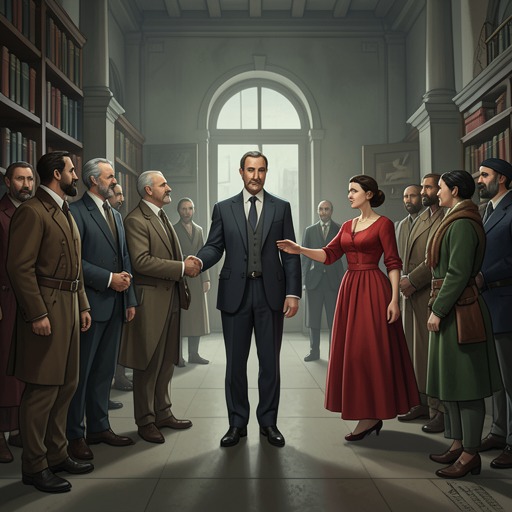
Perón enters the narrative through his relationship with Eva Perón, then a young actress known as Eva Duarte. They meet in January 1944 at a charity gala for survivors of the earthquake that had devastated San Juan. Perón, a colonel among the military rulers, mobilizes support for the city. After the fundraiser, he appears on the radio program where Eva earns a living; she is later hired in his department at the Ministry of Labour. Their relationship develops alongside his ascent through government. He becomes secretary of war and vice president, and in 1945, after his military opponents force his resignation and arrest him, his supporters organize to secure his return.
The mobilization draws workers, unionists, and the underprivileged to May Square in Buenos Aires. Led by the General Confederation of Labour, they demand Perón’s release and restoration to power in front of the presidential palace. Perón marries Eva, and by 1946 the couple stands at the center of a coalition backed by the church, military, nationalists, and working class. Eva becomes his political partner and a public emblem of the movement, while Perón presents himself as the leader who can end Argentina’s dependency and humiliation.
Domestic program and national ambition
As president, Perón announces an aesthetic and industrial revolution and promotes Peronist Justicialism as a route to national distinction. His public style is forceful: he uses radio addresses and speeches before crowds to promise a new beginning and a flourishing future. The program is not only rhetorical. Perón strengthens public services, works with the national union, and brings it into the state apparatus. He also nationalizes the railways, telephone network, and other strategic sectors that had been in foreign hands, while challenging the privileges of the agricultural oligarchy.
Eva’s public work gives the government’s social promises a visible form. As secretary of welfare, she receives trade-union delegates, visits hospitals and factories, opens road sections, and distributes practical goods, including sewing machines and dentures. Her foundation assists poor and working-class people, and her travels carry the movement’s message beyond the capital. In 1947, on her so-called rainbow tour, she is received by Pope Pius XII and several heads of state. The pair’s political image therefore joins state-directed development to public spectacle and personal allegiance.
Perón’s ambition extends beyond domestic modernization. He interprets the war as a contest in which fascist Italy and Nazi Germany had offered an alternative to communism and capitalism, and imagines Argentina taking the place of the defeated Axis powers. In his vision, the United States and the Soviet Union may destroy one another, leaving Argentina positioned to become a world power. The book connects this geopolitical fantasy to a practical effort to acquire the people and expertise needed for industrial and military development.
Argentina as a refuge
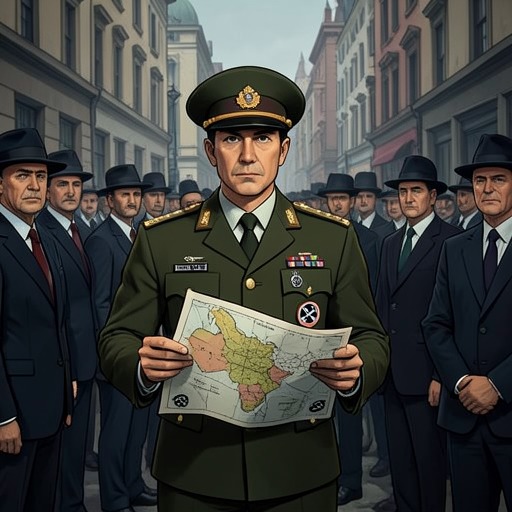
Perón’s government welcomes thousands of Nazis, Fascists, and collaborators, including soldiers, engineers, scientists, technicians, and doctors. The account describes them as recruits for projects such as dams, missiles, and nuclear power plants, part of a plan to turn Argentina into a superpower. This policy makes the country a destination for fugitives as well as a site of national development.
Perón personally oversees the escape system. His government establishes an Information Office in Buenos Aires under Rudi Freude, the son of Ludwig Freude, a wealthy Nazi banker and major backer of Perón’s victorious 1946 campaign. Perón also sends Carlos Fuldner, a former SS captain, to Franco’s Spain, Switzerland, Rome, and Genoa. Freude and Fuldner coordinate the escape routes known as ratlines: networks of diplomats, officials, intelligence contacts, and clergy that enable fugitives to leave Europe and reach Argentina. In July 1949, Perón extends an amnesty to people who entered under false identities and sometimes receives them at Casa Rosada.
By the late 1940s, Buenos Aires has become a gathering place for political and military remnants of the defeated European far right. The arrivals include Ustaše, Serbian ultranationalists, Italian Fascists, Hungarian Arrow Cross members, Romanian Iron Guard legionnaires, Vichy French, Belgian Rexists, and Spanish Falangists. The narrative’s image of a ghostly Fourth Reich captures the consequence of Perón’s welcome: a national policy of recruitment and refuge allows exiles from defeated regimes to regroup in a new political setting.
Fall from power and the refuge’s afterlife
Perón’s rule ends amid mounting conflict. In June 1955, anti-Perónist military leaders bomb the presidential palace and May Square. The ensuing confrontation with the church and the military deepens the crisis; by September, mutinies and the threat of further violence bring Argentina to the edge of civil war. Perón resigns, burns compromising files, and escapes aboard a Paraguayan gunboat bound for Asunción. A military junta takes power, followed by a government led by Pedro Eugenio Aramburu, which promises to purge Peronism. Perón’s removal does not erase the networks or the consequences of the earlier refuge policy.
Later efforts to pursue Josef Mengele show how national jurisdiction and political protection could frustrate prosecution. In 1959, after an arrest warrant is issued in Freiburg im Breisgau, Mengele’s associate Hans Sedlmeier warns him, and Mengele flees Argentina for Paraguay. The warrant and extradition pressure come after Perón’s fall, so they are not actions of Perón’s government; they reveal the continuing difficulty of undoing the conditions created by postwar flight and refuge. Paraguay refuses to extradite Mengele, citing his citizenship and national sovereignty. In 1963, Konrad Adenauer offers substantial aid if Paraguay delivers him, but the offer does not change the refusal. The following year, the West German government publicly identifies Mengele as a Paraguayan citizen who travels in the tri-border region and Brazil, while Paraguay rejects West German pressure as interference.
The capture of Eichmann in 1960 marks a further shift: journalists converge on Buenos Aires, Argentina faces pressure to demonstrate that it is not a Nazi sanctuary, and a warrant for Mengele’s arrest follows. Decades later, testimony by Mengele’s victims at the 1985 mock trial at Yad Vashem, together with a renewed international hunt, brings renewed attention to the crimes and to the failure to capture him. These later events do not belong to Perón’s rule, but they complete the political legacy traced through his character: the state that had recruited and sheltered fugitives left a long aftermath in which justice depended on reluctant governments, contested extradition, and international pressure.